A lot of women don’t realize that the bloodwork ordered before pregnancy was mostly designed to catch established medical conditions, not to fine-tune fertility. It looks for things like anemia, rubella immunity, blood type, and thyroid disease. That work matters. But a result can sit inside the lab’s reference range and still be worth a second look when you’re preparing to conceive.
Preconception care is one of my main areas of focus, so here is a walk through the markers I tend to review, what each one measures, and why “normal” and “optimal for fertility” aren’t always the same conversation. None of this is a diagnosis or a protocol. It’s meant to help you have a more specific conversation with your own provider.
Why the timing matters
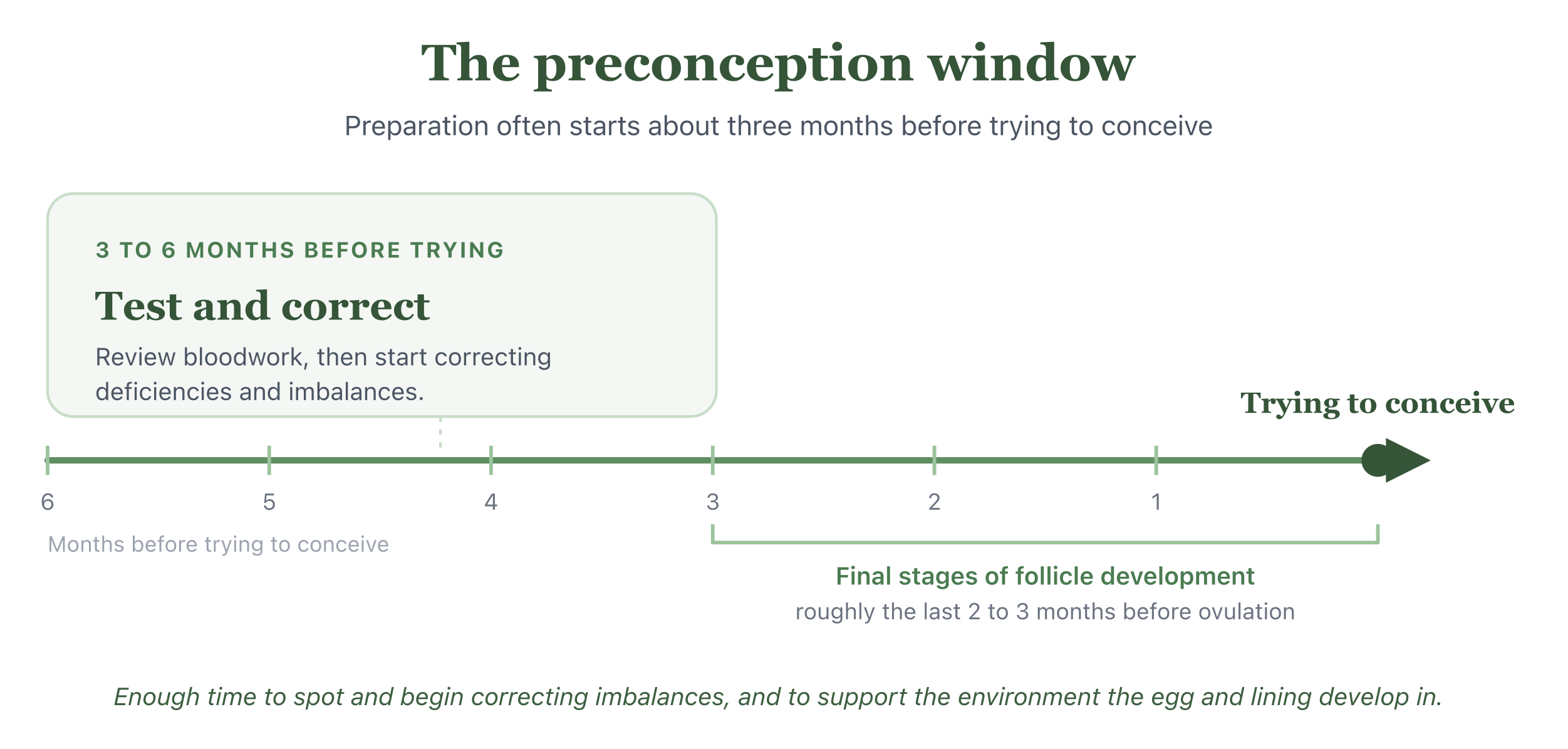
The follicle that eventually releases an egg develops over many months, with important stages of growth happening in the final two to three months before ovulation. That’s one reason preconception preparation is often started around three months before trying.
Nutrition, sleep, metabolic health, and certain nutrient levels may influence the environment the follicle develops in. None of them guarantees a particular outcome for any single egg. But that window is enough time to identify and start to correct deficiencies or imbalances that show up on bloodwork, and to support the environment the egg and the uterine lining develop in.
Thyroid: TSH is the start, not the whole story
TSH (thyroid stimulating hormone) is the main screening marker, and your doctor may have already run it. Depending on the result and your history, free T4 and thyroid antibodies (TPO and thyroglobulin) can add useful information. Free T3 is helpful, but it isn’t routinely needed in every fertility assessment.
Here’s where the reference range gets nuanced. For someone already taking thyroid medication, clinicians commonly aim for a preconception TSH below 2.5 mIU/L, particularly heading into early pregnancy.
For someone who isn’t being treated for a thyroid condition (such as hypothyroidism or Hashimoto’s), a TSH between 2.5 and 4.0 is best interpreted alongside free T4, antibodies, symptoms, and history.
I do want to highlight that thyroid antibodies are worth a mention on their own. High thyroid antibodies have been linked with a higher risk of miscarriage in some studies, even when other thyroid markers (TSH, T3, and/or T4) look normal, though it may be a marker of autoimmune activity rather than the sole cause. Many antibody-positive women never develop clinically significant thyroid disease, which is exactly why the full picture matters more than any one number.
Iron panels: hemoglobin, iron, and ferritin are not the same test
A routine complete blood count (CBC) includes hemoglobin, the iron-containing protein in red blood cells that carries oxygen. What it does not show is how much iron your body has stored. That’s ferritin, and it has to be ordered separately.
Hemoglobin is often the last marker to drop, so you can have a completely normal hemoglobin and a low ferritin at the same time. In my practice, I see a lot of women walking around with a ferritin of 15 to 30 (which is far too low) and they are dismissed for having “low iron” because their hemoglobin levels are still normal.
Ferritin below 30 µg/L generally raises concern for depleted iron stores, even with normal hemoglobin, and has been associated with unexplained infertility in observational research. The right target depends on symptoms, menstrual blood loss, inflammatory markers, and the rest of the iron panel. I always aim higher than 30 clinically, but that’s a practice preference, not a research-established fertility cutoff.
One study is worth knowing here, with its context intact. In a 2025 retrospective study of 292 women with infertility and ferritin at or below 30, outcomes were better after intravenous iron treatment: live birth increased from 26% to 51%, and miscarriage dropped from 28% to 13%. Because it was an observational before-and-after study, it shows an association, not proof that iron treatment alone caused the improvement, since fertility care and time also played a role.
Two more notes on iron:
- Read ferritin with an inflammatory marker when it doesn’t fit. Ferritin rises with inflammation, so a normal or high ferritin can be falsely reassuring. When it doesn’t match the rest of the iron panel, CRP (C-reactive protein) or another inflammatory marker helps with interpretation.
- Low iron shows up in more than fertility. It’s one of the more common contributors to fatigue, hair loss, restless legs, and low mood. Iron deficiency may also affect energy production and thyroid function, though more research is needed on whether treating it directly improves egg quality or the uterine lining.
If fatigue is part of your picture, the guide on naturopathic support for fatigue and low energy covers the iron conversation in more depth.
Fasting insulin: the test most women have never been offered
When I bring up insulin resistance in a fertility appointment, the most common response is some version of “I don’t have PMOS (polyendocrine metabolic ovarian syndrome, formerly PCOS) and I’m not overweight, so does this apply to me?”
Sometimes it does. A standard fasting blood sugar alone can miss early insulin resistance. Measuring fasting insulin alongside fasting glucose lets us calculate a score called HOMA-IR, which reflects how hard the body is working to keep blood sugar normal. Normal blood sugar with elevated insulin is a pattern you won’t catch without ordering insulin, and it isn’t on standard panels.
In one study of more than 3,600 women who had IVF or ICSI fertility treatment, women without PMOS who had the highest levels of insulin resistance were about 4 times more likely to have a late miscarriage than women with the lowest levels. This study only looked at women having fertility treatment, so the results do not apply to everyone trying to get pregnant naturally. Insulin resistance has been linked to problems with ovulation and lower pregnancy success, especially in women with PMOS and those getting fertility treatment. Research in women without PMOS is still ongoing. Because of this, I see a fasting insulin test as one helpful clue when it fits the person’s situation, not as a test that everyone trying to get pregnant needs.
Vitamin D
Vitamin D is often included in fertility testing, but understanding the results isn’t always straightforward. Many guidelines consider a blood level of about 50 to 75 nmol/L to be the minimum needed for overall health, although the exact ranges can vary between laboratories and clinical guidelines.
As a naturopathic doctor, I usually aim for vitamin D levels that are higher than this minimum. My goal is to support what I consider an optimal range for health and fertility, rather than simply reaching the level that is no longer considered deficient.
Vitamin D deficiency is worth identifying and correcting before pregnancy. Some studies, particularly in IVF populations, have linked vitamin D sufficiency with better pregnancy or live birth rates. Others find little association, and the research hasn’t established a separate, higher fertility-specific target above the usual adequacy range. Vitamin D receptors are present in the ovaries, endometrium, and placenta, which supports a plausible role in reproductive physiology, but that alone doesn’t prove supplementation improves fertility.
In Ontario, vitamin D follows the seasons. A lot of women enter the preconception window depleted after winter, so a February result can look very different from a July one. Standard prenatal vitamins usually contain a small amount, so whether that’s enough depends entirely on your starting level. This is a clear case of test, don’t guess: vitamin D is fat-soluble and accumulates, so I don’t recommend blanket dosing without checking a level first.
The cycle hormones
This last group tells you the most about what your cycle is actually doing.
Progesterone. A mid-luteal phase progesterone can help confirm that ovulation likely occurred, which is genuinely useful information. What it can’t do is reliably diagnose overall luteal-phase quality on its own, since progesterone is released in pulses and fluctuates through the day. Timing is everything. It’s usually drawn about six to eight days after ovulation, or roughly a week before the next expected period, not automatically on cycle day 21. Day 21 assumes a textbook 28-day cycle with ovulation on day 14. If you ovulate later, or your cycle is irregular, a day-21 draw can miss the peak entirely. An ovulation predictor kit can help estimate timing of when you should be ovulating, though it doesn’t confirm the exact day ovulation happened.
AMH (anti-Müllerian hormone). AMH reflects the pool of recruitable follicles, a rough sense of ovarian reserve, not the exact number of eggs remaining. It’s most useful when there are risk factors for reduced reserve or when planning fertility treatment, and it’s part of the updated PMOS diagnostic framework. It should not be used alone to predict natural fertility, egg quality, or how many fertile years you have left. If your AMH has come back low, the post on low AMH and diminished ovarian reserve walks through what that number does and doesn’t mean.
Day 3 FSH and LH. These blood tests can give more information about your ovarian reserve, especially if your AMH result doesn’t match your symptoms or if you have risk factors for lower egg supply. FSH (follicle-stimulating hormone) is usually tested early in your menstrual cycle, around days 2 to 4. A high FSH level during this time can be a sign that your ovaries are working harder than usual to grow an egg. This may suggest a lower ovarian reserve, meaning there may be fewer eggs remaining. However, FSH changes from one cycle to the next, so it should not be used on its own. FSH is best interpreted together with estradiol (estrogen). If estradiol is already high early in the cycle, it can lower the FSH level, making the result look more reassuring than it really is. LH (luteinizing hormone) is less useful for checking ovarian reserve. Instead, it can help when looking into irregular ovulation or when PMOS is suspected.
What to bring to your next appointment
Testing well before you plan to get pregnant gives time to act on whatever comes up. Here’s a summary of where standard bloodwork and a fertility-minded review often differ.
| Marker | Usually on a standard panel | Worth reviewing for fertility |
|---|---|---|
| Thyroid | TSH alone | TSH, and depending on history, free T4 and thyroid antibodies |
| Iron levels | Hemoglobin (via CBC) | Ferritin and a full iron panel, read with an inflammatory marker to confirm accuracy of levels |
| Blood sugar | Fasting glucose | Fasting insulin alongside glucose to calculate HOMA-IR, when indicated |
| Vitamin D | Sometimes included | Tested and interpreted with the season and your starting level in mind |
| Cycle hormones | Rarely | Progesterone timed to your ovulation, plus AMH or day 3 FSH and LH when relevant, and testosterone if PMOS is suspected |
Testing should always be based on your personal health history and symptoms. Depending on your situation, other blood tests may also be helpful, such as vitamin B12, HbA1c (a measure of average blood sugar), prolactin, and routine prenatal screening.
If you live in Ontario, there may be a lower-cost option. Many of these tests can be ordered by your family doctor or nurse practitioner, and some may be covered by OHIP when they are medically indicated. It’s worth asking your primary care provider before paying out of pocket.
If you have extended health benefits, your insurance plan may also cover bloodwork ordered through your naturopathic doctor, depending on your policy. Check with your insurance provider to see what is included in your coverage.
If any of these haven’t been part of your preconception bloodwork, bring this list to your next appointment.
If you’re in Ontario and want help mapping out the next few months, you can book an appointment. As always, I recommend taking it one step at a time. You don’t need to overhaul everything at once.
Research cited
- The Practice Committee of the American Society for Reproductive Medicine. Subclinical hypothyroidism in the infertile female population: a guideline. American Society for Reproductive Medicine.
- The Practice Committee of the American Society for Reproductive Medicine. Fertility evaluation of infertile women: a committee opinion. American Society for Reproductive Medicine.
- Ott J, et al. Iron status in women with infertility and controls: a case-control study. PMC. 2023.
- Association between iron deficiency and fertility outcomes following intravenous iron treatment: a retrospective study. PMC. 2025.
- Homeostatic model assessment for insulin resistance and late miscarriage in women undergoing IVF/ICSI. Frontiers in Endocrinology. 2022.
- American College of Obstetricians and Gynecologists. The use of antimüllerian hormone in women not seeking fertility care. ACOG Committee Opinion. 2019.